Final Product and Reflection

After about two weeks of working on this website, I am happy with the final product. I think that the most challenging and time consuming part for me was relearning how to do HTML and CSS from the beginning of the semester. That seems like ages ago! But, between CodeAcademy and going over how to do things in class I managed to include everything that I wanted to.
I redid my KUMU map so that it would be color coded and easier for other people to read, I included an image to go behind all of the text on the site to make it visually appealing and I learned how to imbed a link. What better link to embed than the link to the school that you’re referencing, right?
Overall, I am content with how it turned out and am excited to say that I know have a better understanding of HTML and CSS.


http://module3.emmabaumgardner.com/umw_network_module/webpage.html

HTML and CSS

Earlier in the semester, we took a tutorial on how to utilize code academy to learn about html and css. This was interesting at the time, however now it is super relevant because that is what we are using to create a webpage for the third module. I am currently taking a computer science class that uses python for the coding so switching between that and html can get quite confusing due to their differences.   In html the white space between lines does not matter and it does not go well if you add spaces in certain areas and not others whereas in python, spaces are used constantly and matter greatly.
I am super excited to see how the webpage turns out and really have enjoyed learning how to code in so many different ways this semester.

Methodology intro

For our third and final model we will be selecting a module to work on from the methodology category.  I have selected to work on the one about networks and how connections are formed. I am hoping to make a visual network using kumu.io to show the network of people that I have met during my two years here at Mary Washington. I recently attended a conference in Baltimore and one of the seminars was about networking and connecting with individuals. This was a message that resonated with me so I figured I might as well map the ones that I have so far!

This module is slightly different than the other two in that we will not be working on them with a group of others but rather individually. At the end of it, we will have a hand coded html webpage where all of our findings will be displayed.

Learning WordPress

WordPress, what is powering this site is an incredibly useful thing to know how to use. Mary Washington has a great program called Domain of One’s Own where each student gets a domain of their own should they choose to set it up. Before this year, I had no idea how frequently I would be using it nor did I realize how useful it would be. Last semester, I used it for the first time in my COMM 206 class, Small Group Communication. It was a great way for all members of our group to publicly display all of the information that we had learned in regards to our topic.

Currently, I am using wordpress to power a site for my History of Technology class. On that site, my group mates and I are working on building a site all about how Tupperware came to be a common household technology and the brand new marketing techniques that went along with it. Since I have spent more time working with WordPress between this class and my COMM 206 class from last semester, I am learning how to make the sites look better as well as how to add new pages, drop down menus and change the overall appearance of the site.

This site however, serves an entirely different purpose. While the other two sites are used to display information directly related to one group project, this site is used to talk about all of the different projects and things that are going on in my Digital Studies 101 class.

It’s been fun to see what different things I can learn about WordPress and how to make each site visually very different.

People Absorb Energy From Others, Or Do They?

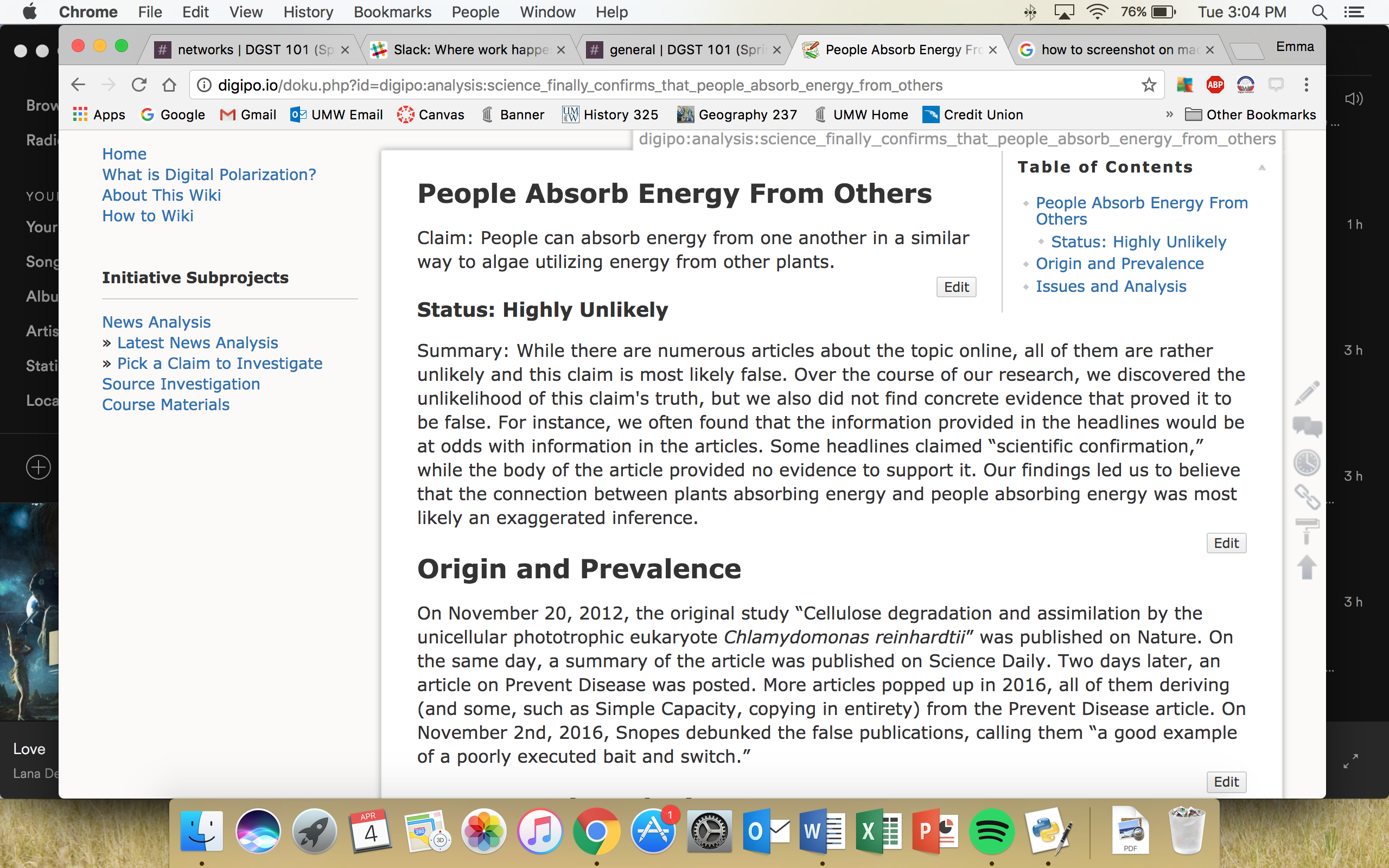
For the digital polarization assignment, our group did research on whether or not the claim of “People absorb energy from others” was true or false. These claims were posted to a wikipage where anyone can make edits.  Our claim specifically had no comments prior to working on it unlike some of the other groups in the class. This means that all of the information posted was found by each of us rather than someone else in a different class, or setting posting to the page.
While conducting our research, we used digipo and hypothesis. We used hypothesis to annotate pages and the digipo was used to tag the annotated sites to our specific claims. The claim was based around research done by a team in Bielefeld University studying a specific strand of algae. This algae was able to absorb energy via photosynthesis as well as from other plants. People then began comparing this plant to a human’s capabilities. Energy healer Olivia Bader-Lee said that people absorb energy from others in the same fashion and that this was an explanation for why people feel comfortable or uncomfortable in certain social situations.

One of the possible reasons that we think that this claim was made was due to a miscommunication. While the research behind the algae is valid, the corresponding claim in regards to humans is not so much. I think that Bader-Lee was probably saying that maybe this could serve as an explanation but there was never any proof of it relating to humans and word of mouth spread the rest. The first instance that we could find of this claim came out in 2012, but we also found more articles related to the topic from 2016. After having done our research, we have come to the conclusion that this claim of people absorbing energy from others is highly unlikely. Each article was using the same claims and the same quotes which means that they likely did not do any further research from the articles before them which contributes to our belief that this claim is unlikely.


Real or Nah?

After having listened to Mike Caulfield’s talk, we have been working on activities with reading laterally in class. Mike Caulfield has a book titles “Web Literacy for Student Fact Checkers”. In this book, there was an activity where two pictures were posted in the book and we had to decide whether or not these pictures had been photoshopped or if they were in fact real.
This was a good exercise because it taught us how to find out whether or not a source was accurate, posted with truthful information and is in fact real. It was the perfect segway for the next activity that we have been working on in class called “Digital Polarization”.  In this activity, we had to choose a claim on a wiki and do online research, read laterally and learn where the information related to our claim was coming from. More details about this activity to come….

Mike Caulfield talk

Earlier this month, Mike Caulfield came to the University of Mary Washington to give a talk about digital literacy. His big takeaways were for us to be more aware of how we get and absorb information online. One of the ways to do this is by reading laterally, this basically means that we should be aware of links that are tagged within a post, seeing where this information came from and whether or not it is reliable information.

He also talks about the pros and cons for the CRAAP model. CRAAP stands for currency, relevance, authority, accuracy and purpose. People typically don’t follow this and tend to rely more on the individual posting this information to have done their research rather than checking on it as well.

“Know thy Selfie”

Mark Marino,  a professor at University of Southern California created this prompt for his students to learn more about race and identity. The prompt was how do our selfies produce and obscure a sense of our identities. For this post, I will be analyzing how sexuality, gender, race, and socioeconomic status are portrayed in my pictures.

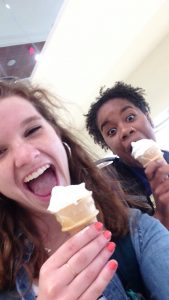
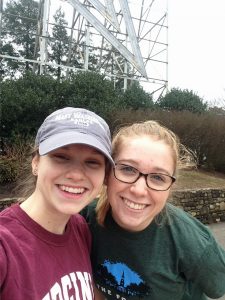
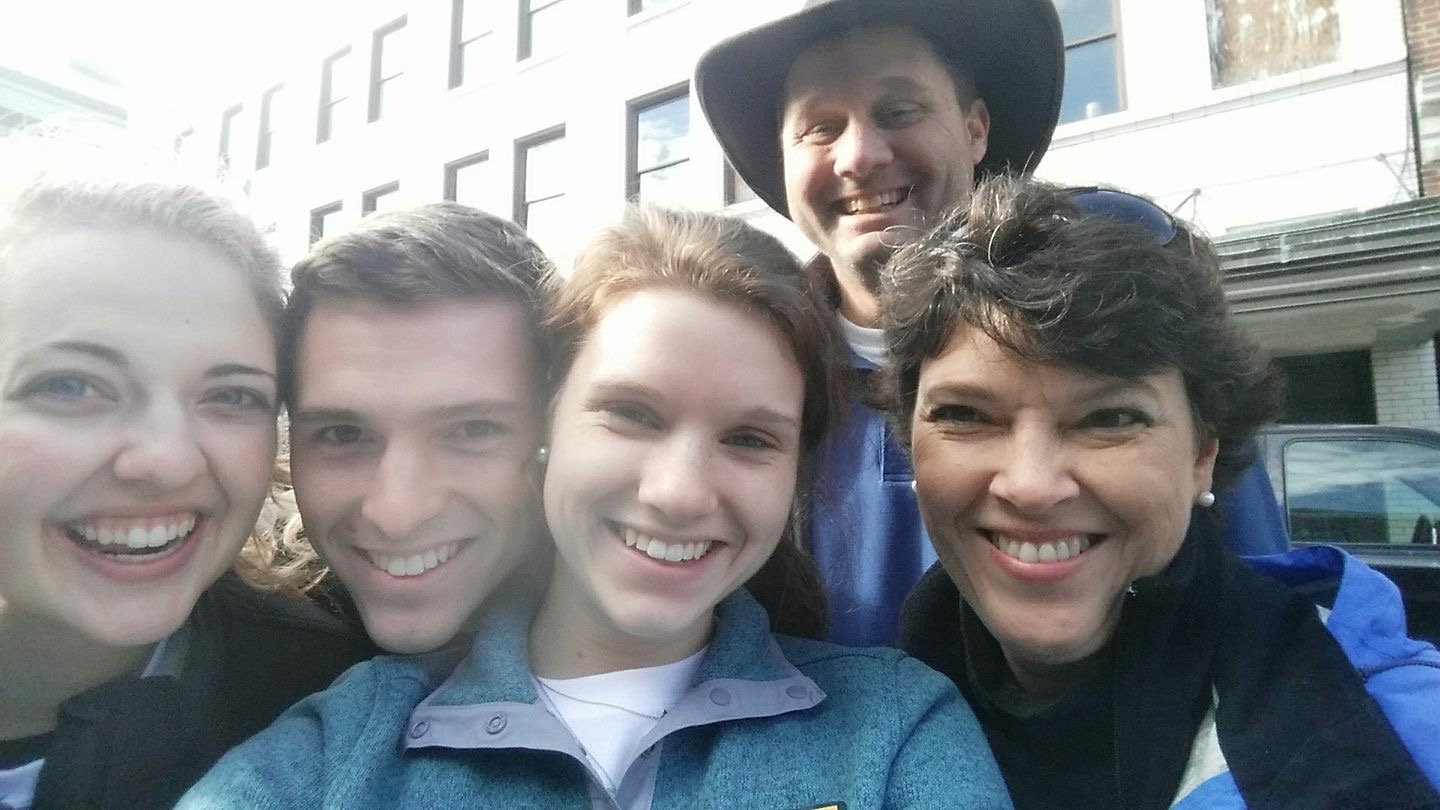
Of the five selfies that I have chosen to analyze, the majority of them were taken with one other female. The others were either taken with either my family or with my boyfriend. I think that overall, each of the selfies was an accurate portrayal of both my friends and myself.

Typically, the selfies that I take are after reaching an intended destination, at an event with a group of friends or something that we wanted to show that we’d done. From these selfies, you can see that I enjoy sweets, and being outdoors. Rarely do I take individual selfies. I think that my selfies could be considered ambiguous because I do not have a set group or person that I take selfies with, it tends to be more spontaneous.

In regards to how socio economic status, gender, sexuality and race are portrayed, most of my selfies do tend to be with white, middle class heterosexual people. While I do have friends that are some or none of those qualities, we do not take pictures together quite as often. In all of the pictures we are typically smiling, wearing everyday clothes and in decent lighting.

After having completed this module, I learned that everyone takes and interprets selfies differently. Some people regularly post selfies to Instagram, Facebook, etc. I personally do not like posting pictures of myself individually, so that is not something that I take part in. I much prefer taking pictures with other people, sometimes in selfie fashion. I think that this module was interesting because it helped me to think of selfies in a way that I hadn’t previously. The assignment that Marino had his students do made them analyze who they were taking pictures with, what was the intended focal point of the picture, what kinds of clothing were people wearing and how was the camera angled. I think that this is something that we all subconsciously are aware of when taking the selfie. However, it was interesting to see how these applied to selfies that I had taken.

Here are the 5 pictures that I based these findings on:



Culture Module

For the next module that I will be working on, I will be looking at the different ways in which selfies are used on different social media platforms as well as how a person displays their internet persona. Selfies are something that has become a cultural craze over the past few years, however rarely do people reflect on the impact of the selfie and how people tend to befriend people online that look similar to themselves.

I’m interested to learn more about the culture behind the selfie. I’m also curious to see how my digital persona is portrayed and what it looks like after analyzing my online friends.